Text: Bernd Huck
Sidestep: Transnistria
The training centre was a gift from Joseph Blatter. At any rate, FIFA made a generous facility for the country’s national teams possible to promote football in the Republic of Moldova. That is where our tournament took place.
The facility lies right on the River Dniester, which separates Moldova from Transnistria. The river’s Romanian name is Nistru, and it gave Transnistria its name: beyond the Nistru.
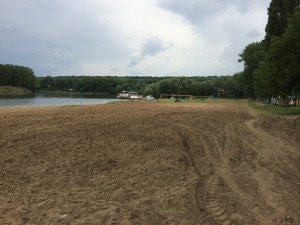
Plaja Vadul lui Voda on the Dniester.
On the Moldovan side, sand has been piled up to form the Plaja Vadul lui Voda; on nice days the locals come here to relax.
Better not swim across, we had been advised. The bridge over the river a few hundred metres away was impressively guarded by a tank. On the other side, a Transnistrian in camouflage gear patrolled from time to time. So we decided not to swim across.
Transnistria is called “the last Soviet museum in the world”. Tiraspol is the “capital”; a stone Lenin keeps watch in front of the seat of parliament, which is still called the “Supreme Soviet” here. Its flag bears the hammer and sickle. Transnistria has 500,000 inhabitants and lies in the east of the Republic of Moldova, a narrow, elongated strip enclosed by Ukraine. A country that doesn’t actually exist. And yet it has its own currency, the Transnistrian rouble, its own parliament, a head of government, even a secret service and a national anthem.
It is the only country on earth that is not diplomatically recognised by any other. Internationally, the matter is considered a “frozen conflict”. Which merely means: after the civil war of 1992, when the Moldovans tried to retake the region and hundreds of people lost their lives, there is calm for the moment and the guns are silent.
There is no solution in sight.