Text: Friedhelm Römer
Football as a Magnet
The unifying power of football is celebrated and lived anew every year when journalists from all over the world meet for a large international small-sided tournament – as in May 2016 at the beautifully spruced-up sports complex in Gniewino. It is no coincidence that the many training pitches bear Spanish names such as Madrid, Barcelona or Seville: during Euro 2012 in Poland and Ukraine, eventual European champions Spain prepared for the tournament at this Mistral sports hotel site, among others. Now twelve journalists’ teams from Lithuania, Latvia, Hungary, Russia, Germany, Slovakia and of course Poland are competing for the title here.
But really it’s about more than that: social contacts between sports-loving people from completely different cultures. “It’s a good thing, and there are lots of good footballers playing here too,” says Sławomir Chałaśkiewicz. In the 1990s the 52-year-old Pole was a professional footballer, including with Hansa Rostock in the first and second divisions. What makes this tournament special: each team may field one former professional. Sławo and his team only narrowly missed the semi-finals.
Since 2013, Chałaśkiewicz has run a private football school for children aged five to twelve in Łódź, with 50 kids taking part; the older ones train six times a week. “We are proud to be here. We’re glad we were invited,” says Victor Sobirins. The 27-year-old is captain of the Latvian team. For him, the “social contacts” are important; his team and the Lithuanians have had close ties for years. “Football works like a magnet. It brings teams and people together,” he says.
The Lithuanians are among the most sociable teams in Gniewino. “We get on well with many 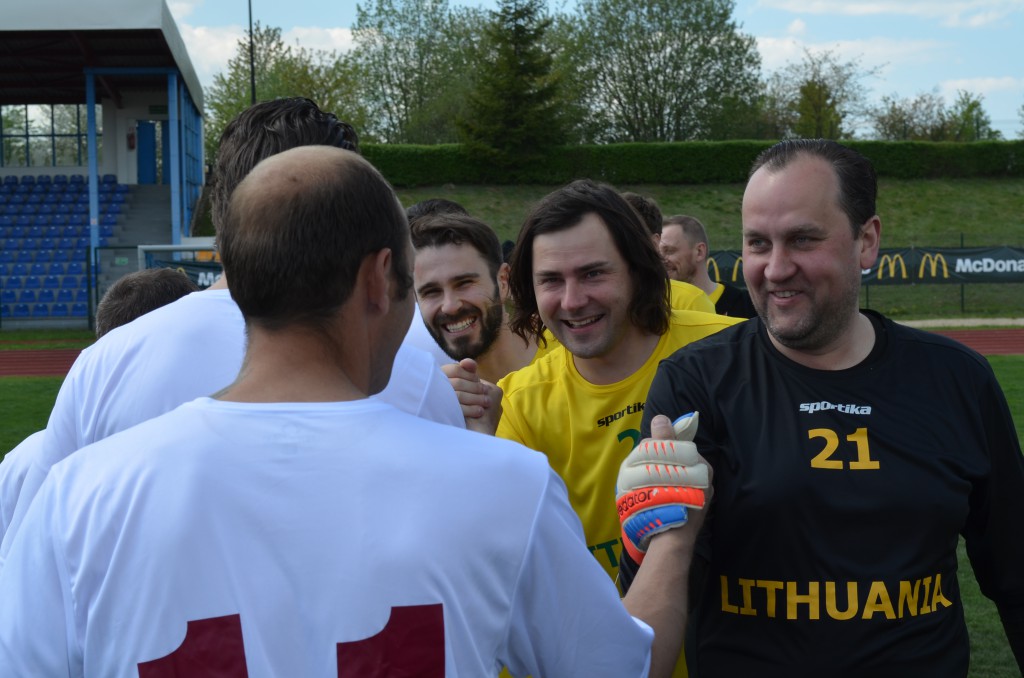 teams,” says Roman Burstein, naming Latvia, Germany and Russia. “We helped the Russians get the visas they needed because they were travelling into the Schengen area.” Sergei Osipov is also very taken with the atmosphere. The 50-year-old Russian always looks forward to these tournaments “because we meet our friends from Germany and Lithuania here”. His team had come a long way: a 16-hour, 1,400-kilometre drive from Bryansk – around 400 kilometres south-west of Moscow – to Gniewino. And then the shock ran deep at first, as the Russian team’s sporting involvement was over after the group stage. But Sergei Osipov and his teammates quickly recovered from that in the evening at the big buffet, with the odd vodka or two.