2024 Moldova

Chișinău, 19 May 2024
This time the matches took place right in the capital of Moldova, in a stadium for five-a-side games.
For years, Moldova has been the fifth least popular travel destination in the world.
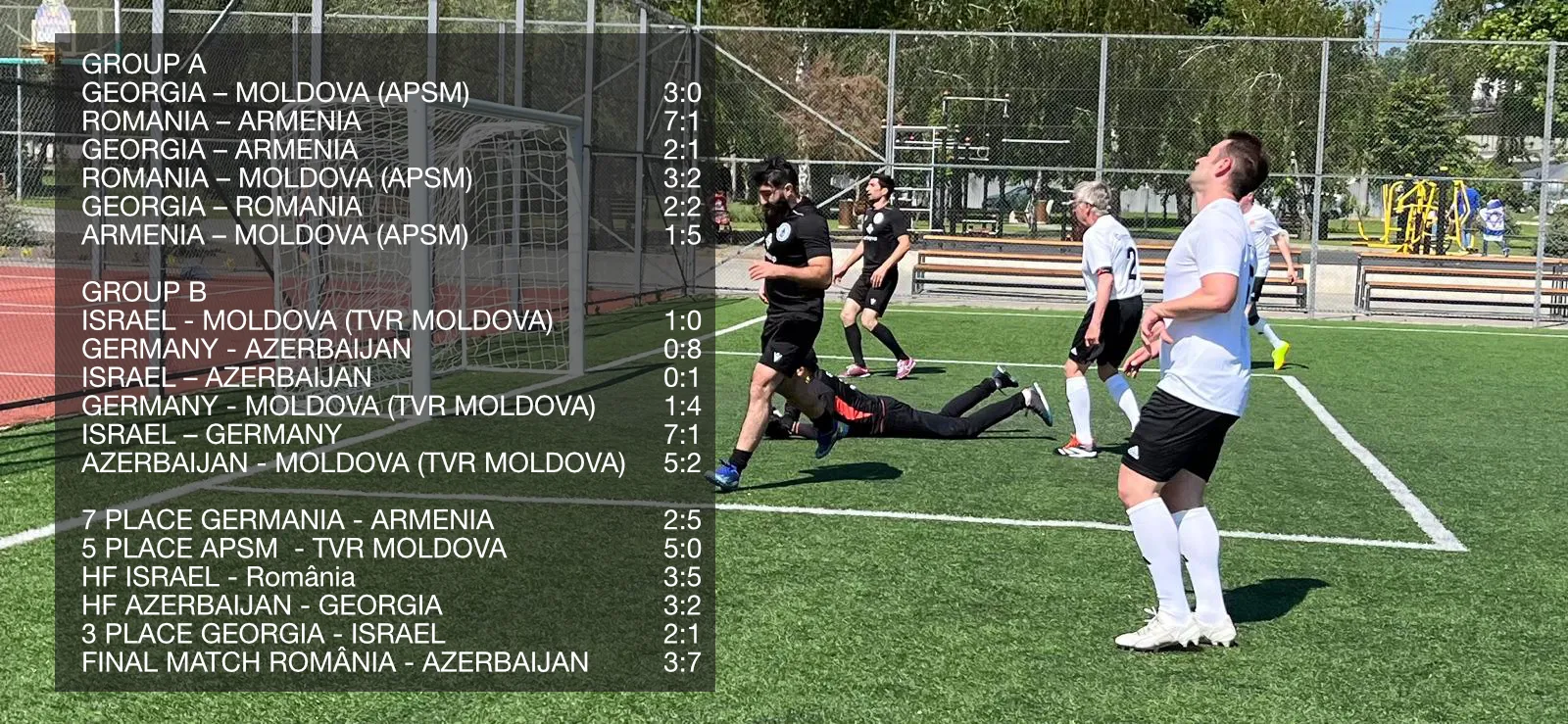
The German team fully met expectations and finished last.
Ten years ago we finished fifth – one of our best results ever. This year we at least managed to score four goals! A solid eighth place was the final result on paper.

Confidence and anticipation before the tournament on the steps of the Maria Bieșu National Theatre of Opera and Ballet. Its namesake, by the way, is an internationally renowned soprano.

View from the hotel room: opposite is the Saint Apostles Peter & Paul Church.

A look into the basement of the Saint Apostles Peter & Paul Church. The church is being completely renovated, but the basement with its many devotional objects is open.

These were the trophies at stake. None of them made it into the German team’s trophy cabinet.

Plenty of media representatives attended the opening ceremony.

At the opening ceremony, organiser Eduard Ciobanu presented captain Klemmi with a welcome shirt.

The matches were played in the FMF Beach Soccer Arena. The flexible stadium seats up to 1,500 spectators plus 244 VIP seats. The surface can be changed: sand, artificial turf or futsal flooring.

Team Germany in the smart new jackets from our new sponsor Intersport Voswinkel.


Yasin showed great stamina and technical skill, here in the match against Armenia.

Reza’s speed and dynamism, here against Moldova, repeatedly created goal-scoring chances.

The renaissance of classical ballet: the basis of posture is the vertical and the en dehors (turning the legs outwards from the hip joint). Ballet positions include, for example, the arabesque (extended working leg) and the attitude (bent working leg).

Full of optimism and looking forward to the next opponent. Many thanks at this point to our new shirt sponsor Intersport Voswinkel!

Yasin and Klemmi in the final match against Armenia.

An Israeli team took part for the first time – a strong side that made it to the semi-finals.

Marvelling underground: the second-largest wine cellar in the world has a 120 km network of tunnels and lies almost 100 m below the surface.

Ten years ago you could still admire the collections of individual people; since then they have been re-sorted by country. As a result, the bottles of Angela Merkel and Hermann Göring are now part of the same collection.

The oldest wines of the huge cellar are kept here behind glass. In the middle, the oldest bottle, from 1902, from East Jerusalem – a red dessert wine. On the right a Moselle wine of unknown age. Both wines are believed to still be drinkable. It will remain a belief.

Cosmonaut Yuri Gagarin had the curious wish to fill the cellars with an abundance of medals for the wonderful wines. Should there not be enough metal on Earth, he promised to fetch it from the Moon or other planets.

Dinner in the wine cellar after the tournament.

As a magnificent eighth-placed team, the Germans were of course in high spirits at dinner in the second-largest wine cellar in the world.

Reza was one of the best on the pitch – and later a delighted wine connoisseur.

In vino veritas. And good food fills you up. And cheers you up: debutant Guido and goalkeeper Matthias are in excellent shape even after the exhausting tournament.

Captain Klemmi – who has since become German champion with Inter Berlin. He also delivered a commanding performance in the wine cellar.

Dinner consisted of four delicious courses, accompanied by Cricova wines. Here Joscha and Bernd.

Piața Centrală – a market hall in Chișinău with stalls for fruit, vegetables, cheese, meat, baked goods and local specialities.

Fresh fruit at the market.

The Church of the Transfiguration in Chișinău: the Cold War space race between the USA and the USSR even affected churches. After Yuri Gagarin’s success in 1961, domed churches were sometimes turned into planetariums, as the Gospel was generally banned – including the Church of the Transfiguration from 1962 until a fire in 1990. After the Soviet era it was restored as a church.

This monument was erected in 1959 with money collected by young Moldovans. It honours the young heroes, the patriots who gave their lives fighting the Romanian invaders.

The remarkable Cathedral of Christ’s Nativity stands in the lovely Cathedral Park in Chișinău and is considered the most important church in the capital.

The Cathedral of Christ’s Nativity from the inside – lots of detail, lots of gold, lots of icons, but also an illuminated sign.

The “Holy Gate” of Chișinău. This triumphal arch was built in 1840 to mark the Russian victory in the Russo-Turkish War of 1828/1829. Inside hangs a bell weighing 6.4 tonnes, cast from captured Turkish cannons. The arch stands in line with the government building, the bell tower and the Cathedral of Christ’s Nativity – a kind of monumental back four.

A view during a walk. A picture by Reza van Gogh.


 2024 Georgia